Technology

How vaterite works

A porous, metastable mineral that we shape, load and coat to order.

The material

Why vaterite

Calcium carbonate has three crystal forms. Calcite and aragonite are stable and dense. Vaterite is the rare one: porous, high in surface area and metastable. It wants to change, and that is what makes it useful.

Porous

High internal surface

Spherical particles built from nanocrystallites, with open pores that take up molecules, ions and nanoparticles.

Metastable

A built-in trigger

In water, vaterite recrystallises to calcite over time. The rate can be tuned, giving release and reactivity on a schedule.

pH-responsive

Dissolves on demand

Stable at neutral pH, dissolves quickly in mild acid. Cargo is released or the template is removed without harsh chemistry.

Tunable

Size and shape by design

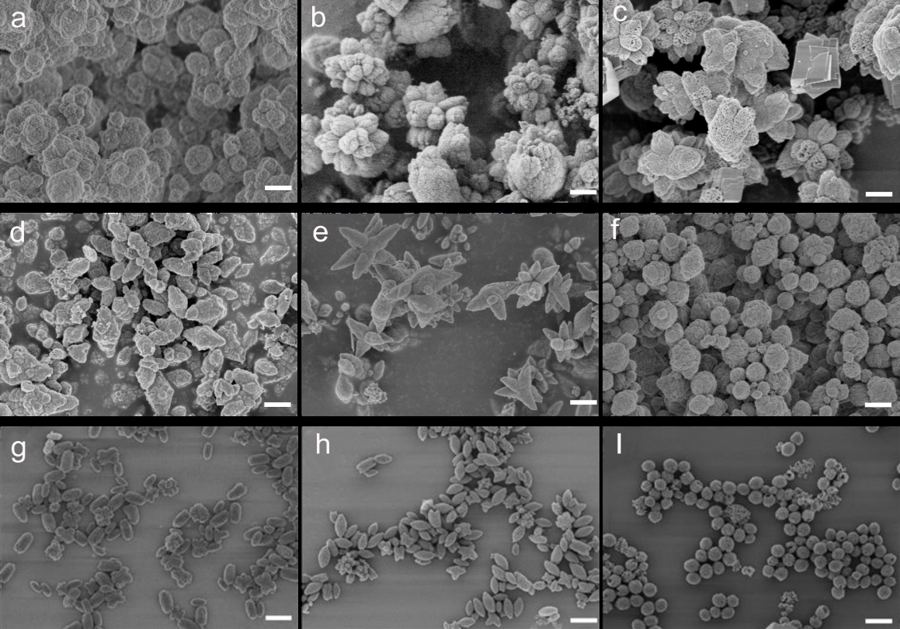
Reproducible control from 0.3 to 10 µm, with spherical, elliptical or star-like morphologies.

Safe

Food-grade chemistry

Calcium carbonate (E170) is biodegradable and non-toxic. It breaks down into calcium and carbonate.

Low-carbon

Synthesised, not mined

Made by controlled precipitation at room temperature. Carbonate can in principle come from captured CO₂.
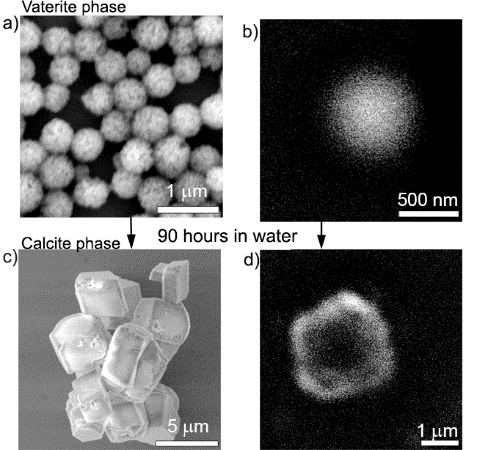
Vaterite recrystallising to calcite after 90 hours in water
Metastable by nature. Porous vaterite spheres turn into dense calcite crystals after 90 h in water. The loaded dye is released.[1]
Different CaCO3 particle morphologies obtained by tuning synthesis
Shapes by design. Changing synthesis conditions gives spheres, ellipsoids, stars and aggregates of controlled size.
Platform

What the particle can do

Each application uses one or more of the same core functions. We develop the particle once and adapt it per application.

Load and release

Fill the pores with an active, add coatings, and set burst, sustained or delayed release.

Sorb and capture

Bind heavy metals, phosphate, dyes and oils from water through the large surface and calcium chemistry.

Template

Coat the particle, then dissolve the core to leave hollow capsules or porous scaffolds of a defined size.

Reinforce and fill

Add mineral particles to cement, polymers and hydrogels to change strength, setting or texture.

Optical and sensory

Spherical porous particles scatter light softly and absorb oil, which matters in cosmetics and coatings.

Data-driven synthesis

Machine-learning models on our synthesis data predict phase and size, and shorten development for each new grade.

time concentration
Single coating: fast releaseMultiple coatings: sustained release
  • Porous carrierLoading up to about 1 mg of active per mg of carrier.
  • Programmable coatingLayer number and composition set the release kinetics.
  • ProtectionThe mineral shell shields the payload during processing and storage.
  • Drop-in powderFree-flowing powder that fits standard production lines.
Why Formyra

How vaterite compares

Each existing option is good at one thing. Vaterite combines a safe mineral with a loadable, tunable structure.

Formyra vateriteSynthetic polymer microcarriersStandard CaCO₃ (ground / precipitated calcite)Lipid and protein encapsulation
Biodegradable, clean labelYes, mineral (E170)Restricted in the EUYesYes
Porous and loadableHigh, ≈1 mg per mgYesNo, dense crystalsModerate
Tunable releaseCoatings and phase changeYesNoLimited
Heat and shelf stabilityMineral shellGoodGoodOften sensitive
Delivery, sorption and materialsSorbents, cement, cosmeticsMostly cosmeticsFillers onlyMostly food

Our edge over other carbonate suppliers is control of vaterite size, shape and loading, backed by 20 years of published know-how and data-driven synthesis.

Intellectual property

Protecting what we build

Public science as base

The published research gives freedom to use the core knowledge of vaterite synthesis and loading.

Patents on applications

Formyra protects new application-specific compositions, scalable processes and release profiles.

Know-how

Food-grade process routes, stabilisation and cost models are kept as trade secrets under NDA.